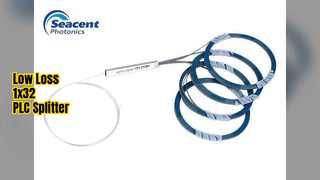
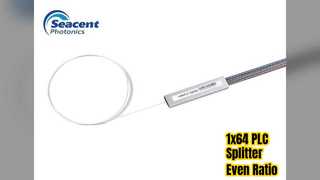
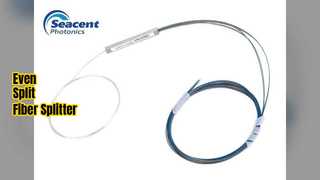
Fiber Optic PLC Splitter 1x6 Bare Fiber G657A1

Fiber Optic PLC Splitter
December 30, 2025
Category Connection: Fiber Optic PLC Splitter
Brief: We tested it—see the highlights and what to expect in real operation. This video provides a detailed walkthrough of the Fiber Optic PLC Splitter 1x6 Bare Fiber G657A1, showcasing its role in FTTx and FTTH networks. You'll see how this passive optical component enables efficient power distribution and learn about its compact design and factory-tested performance in various network applications.
Related Product Features:
  • Compact design for space-saving networking solutions in optical transmission systems.
  • Optical performance is 100% factory tested to ensure reliability and quality.
  • High stability across a wide operating temperature range from -40℃ to 85℃.
  • Low insertion loss, back reflection, and polarization dependent loss for optimal signal integrity.
  • Certified by Telcordia GR.1209 and GR.1221 standards for industry compliance.
  • Utilizes silica optical waveguide technology for efficient optical power allocation.
  • Available in various port configurations including 1x2, 1x4, 1x8, 1x16, 1x32, 1x64, and 1x128.
  • Bare fiber design allows for direct splicing with distribution and drop cables in FTTH networks.
FAQs:
  • What is a PLC Splitter and what is it used for?
    A PLC Splitter, or Planar Lightwave Circuit Splitter, is a passive optical component that uses silica optical waveguide technology to distribute optical power from a central office to customer premises in FTTx and FTTH networks, providing a cost-effective and space-saving solution.
  • What are the key specifications of the 1x6 Bare Fiber PLC Splitter?
    Key specifications include insertion loss ≤9.0 dB, uniformity ≤0.6 dB, polarization dependent loss ≤0.25 dB, return loss ≥55 dB, and stable operation across temperatures from -40℃ to 85℃. It uses G657A1 fiber with customizable length.
  • In which applications is this PLC Splitter commonly used?
    This splitter is widely used in WAN, LAN CATV, metro networks, telecommunication networks, FTT(X) systems, Passive Optical Networks (PON) including EPON and GPON, and as a value-added module in various optical transmission systems.