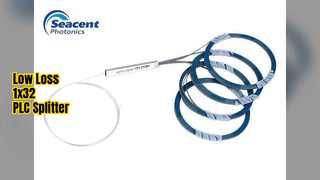
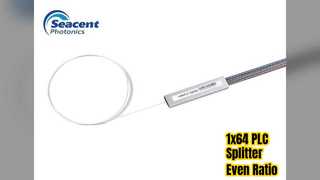
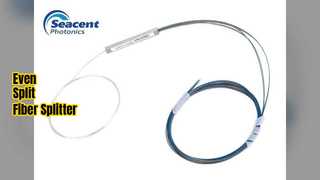
Brief: In this video, we provide a detailed walkthrough of the Bare Optical Fiber PLC Splitter 1x12 Type G657A1, showcasing its application in Metro Networks. You'll see how this component ensures reliable performance in optical transmission systems, including demonstrations of its low insertion loss and high stability across varying temperatures. We also explain the ordering process and key specifications to help you integrate it effectively into your network infrastructure.
Related Product Features:
Features low insertion loss and stable polarization for consistent signal quality.
Offers excellent channel uniformity to ensure balanced performance across all outputs.
Provides high stability and reliability, certified by Telcordia GR.1209 and GR.1221 standards.
Designed for a wide operating temperature range from -40℃ to 85℃.
Supports testing wavelengths from 1260 to 1650 nm for versatile network compatibility.
Enables effective monitoring and management of fiber optical networks with fast installation.
Ideal for applications in Metro Networks, FTTH, and Passive Optical Networks (PON).
Available in customizable fiber lengths and configurations to meet specific project needs.
FAQs:
What are the key applications for the 1x12 G657A1 PLC Splitter?
This splitter is designed for use in Metro Networks, FTTH, Passive Optical Networks (PON), LAN, WAN, and PON-FTTX networks, supporting reliable optical transmission and subscriber loop systems.
What temperature range can this fiber splitter operate within?
The splitter operates effectively within a wide temperature range from -40℃ to 85℃, with temperature stability ensuring performance variations stay within ≤0.5 dB.
How is the insertion loss performance of the 1x12 splitter characterized?
The insertion loss is ≤12.5 dB, with excellent uniformity of ≤1.0 dB across channels, ensuring minimal signal degradation and consistent performance in fiber optic networks.
Can the fiber length and configuration be customized for specific projects?
Yes, the splitter offers customizable fiber lengths (e.g., 1.0m standard or tailored options) and split ratios (1xN configurations), allowing flexibility to meet diverse network requirements.