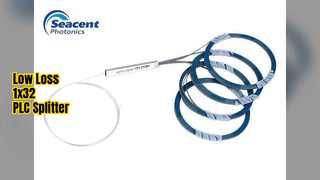
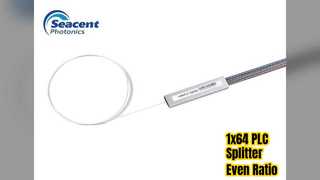
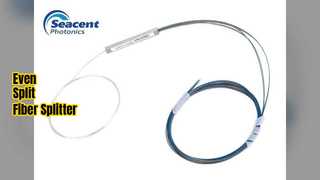
Brief: From concept to demonstration, this video highlights the evolution and practical outcomes of the Low Loss Fiber Optic PLC Splitter. You'll see a detailed walkthrough of its 2x4 configuration, showcasing how it evenly splits signals from two inputs to four outputs. We demonstrate its low-loss performance, stable polarization, and the flexibility of the 900µm loose tube fiber for easy splicing or connectorization, all while explaining its critical role in FTTH and PON networks.
Related Product Features:
Features a 2x4 configuration with an even split ratio across all output fibers.
Provides low insertion loss for efficient signal transmission.
Offers stable polarization and good channel uniformity for reliable performance.
Utilizes 900µm loose tube fiber for easy stripping, splicing, or terminating.
Certified by Telcordia GR.1209 and GR.1221 for quality assurance.
Operates across a broad testing wavelength range from 1260 to 1650 nm.
Maintains temperature stability from -40℃ to 85℃ with minimal loss variation.
Supports customization of fiber length and connector types to meet specific needs.
FAQs:
What is the split ratio of this PLC splitter?
This is a 2x4 PLC splitter, meaning it evenly splits the optical signal from two input fibers to four output fibers, maintaining a consistent split ratio regardless of the input wavelength.
What types of fiber and connectors are available?
It uses 900µm loose tube single-mode fiber, which is easy to strip, splice, or terminate. It can be supplied unterminated or with various connector types including LC/UPC, LC/APC, SC/UPC, SC/APC, FC/UPC, FC/APC, and ST/UPC based on your requirements.
What are the key performance specifications?
Key specifications include an insertion loss of ≤7.5 dB, uniformity of ≤1.0 dB, polarization-dependent loss of ≤0.25 dB, and a return loss of ≥55 dB. It operates from -40℃ to 85℃ and supports wavelengths from 1260 to 1650 nm.
In which applications is this splitter commonly used?
It is ideal for LAN, WAN, Metro Networks, Fiber to the Home (FTTH), Passive Optical Networks (PON), and other FTTX network deployments due to its reliability and low-loss characteristics.